What a Natural Hairline Really Takes
Hairline design is part medicine, part artistry. Here’s what separates an undetectable result from an obvious one.
Hairline design is part medicine, part artistry. Here’s what separates an undetectable result from an obvious one.
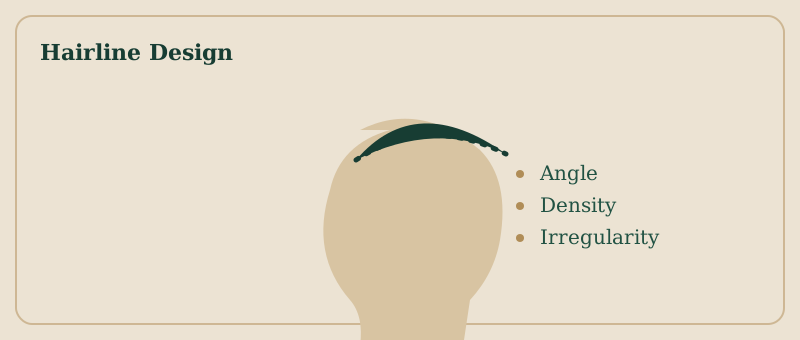
The hairline is the most visible — and least forgiving — part of a hair transplant. A natural result isn’t about packing in as much hair as possible; it’s about recreating the subtle, slightly imperfect way a real hairline grows. That takes planning and a careful eye. Here are the principles behind it.
Natural frontal hair grows forward at a shallow angle — roughly 15 to 20 degrees to the scalp, almost lying against the skin. Grafts placed too upright are one of the clearest giveaways of surgery. Matching the natural angle and growth direction, which changes subtly across the scalp, is fundamental to an undetectable look.
Real hairlines are softest at the very front and become denser behind. Skilled design places single-hair follicular units along the leading edge at a lower density, building to denser multi-hair units further back. This gradient creates a soft, feathered transition rather than an abrupt, obviously-planted line.
Nature isn’t a straight line. Good design deliberately builds in two kinds of irregularity:
Both have to be created intentionally during surgery — and they’re a big part of why an experienced eye matters.
Temporal points and soft temporal recession are easy to get wrong. Overfilled or too-low temples look unnatural and can “age” poorly as surrounding hair changes. A natural design respects the way temples recede slightly and frames the face without exaggeration.
Height matters. Set too low, a hairline can look unnatural now and problematic later as native hair thins. Doctors use anatomical landmarks — such as the glabella (between the brows), the mid-frontal point and the frontotemporal angles — to position a hairline that suits your face and, importantly, still looks right in ten or twenty years.
Because pattern hair loss can continue, a good hairline is planned with your likely future in mind — conservative enough to age gracefully, and mindful of preserving donor supply for the long term. This is where objective assessment and 3D planning help: measuring rather than guessing, and agreeing the design together before anything begins.
This article is general information only and is not medical advice. Results vary between individuals and depend on factors assessed at an in-person consultation with an AHPRA-registered doctor.
Book a consultation to map your options in 3D and discuss a hairline designed for you.
Book a consultation Email us